
|
Shearforce Ltd. Co. |


|
Shearforce Pumps |
|
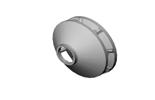
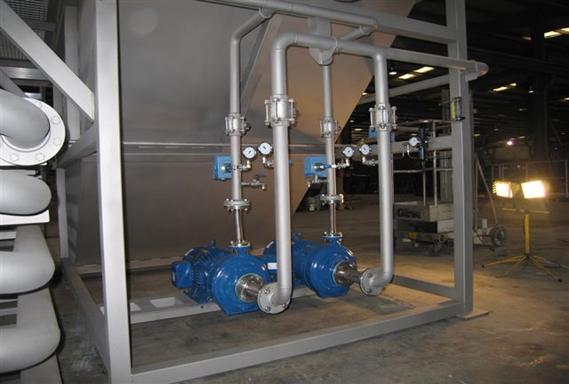
Patented “Shearforce” Rotors A unique concept in pumping fluids Patent No. US 6,752,597 B2 Shearforce Pumps utilize the Patented Shearforce Rotor which is a vane less impeller with non-parallel shrouds. These rotors improves the Sheaforce Pump’s capability of pumping certain applications which are not suitable for standard vane type impellers. These applications include entrained gas (air), high solid content, viscous and shear sensitive liquids. Background:
The background of shear force pumps is as old as the Egyptians when it was used to remove water from the Nile river. The Archimedes pump used a screw (auger) to move material down a cylinder. The rotation of the screw creates a shearing force on the material which drives it down the threads of the screw. The Shearforce Pump or vane less centrifugal pump utilizes the fluid viscosity to generate the necessary forces required to sustain a pressure differential and corresponding flow. As the rotor is spinning, fluid is introduced through the central region where it is radially drawn off through the rotor spaces. Due to the fluid’s viscosity, the fluid is accelerated by the shear forces and assumes a tangential velocity. As the fluid progresses outwardly, the body forces continually develop, sustaining the pressure gradient and flow in the radial direction. Boundary condition states that the normal component of the velocity at a boundary is zero in steady flow. With the Shearforce Pump, the boundary layer (layer closest to the rotating shroud) is stationary, relative to the shroud. As the plates rotate, energy is transferred to successive layers of molecules in the fluid between the plates via viscous drag. This generates velocity and pressure gradients between the shrouds. Vaneless Rotors: Shearforce rotors have specific advantages over conventional impellers and thus are better suited for certain applications. Lower efficiencies are realized with the Shearforce Rotors. Thus, the best applications for Shearforce Rotors are installations where the efficiency can be rationalized or where conventional impellers are not well suited. These applications include entrained gas (air induced fluids), high viscosity fluids and fluids with high solid content. . |

|
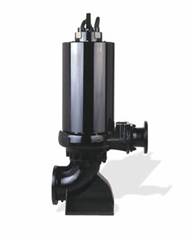
Multi Phase Flow: The Shearforce rotor is ideal for applications which contain multi phases such as water and gas (air). The entrained gas bubbles are passed through the rotor assembly without any attempt to compress the bubbles. A standard centrifugal pump will impinge on the gas resulting in decreased performance. Thus the Shearforce rotor is well suited for difficult applications where entrained gas is present such as crude oil production. Facilities and DAF applications. |
|
Solids Capability: The large spacing between the shrouds of the rotor give the Shearforce rotor tremendous advantages over any other type of impellers. The solids pass through the pump without coming into contact with the rotors. As the solids enter the rotors, they are forced to the low pressure area (I.e. the center of the plates) which is also the high velocity area. This action keeps the solids in the center away from the shrouds. This results in reduced wear and much longer life when compared to a standard centrifugal pumps. The Shearforce rotor is ideal for oil and sand slurries and slurries where it is desirable not to impinge on the fluid. |
|
Viscous Fluids: With Shearforce rotors, the viscousity effects are significant. The efficiency of the Shearforce pump with a Shearforce rotor will be greater then the same pump with a conventional impeller with viscosities greater then 500 cp. Viscosities of 10,000 cp are possible with pumps fitted with the Shearforce rotors. Since the Shearforce rotors use the friction between the layers of the fluid, the rotor operates more efficiently with a more viscous fluid. However unlike all positive displacement pumps such as progressive cavity and twin screw pumps, the Shearforce rotor is capable of handling the solids normally present in viscous products. |
|
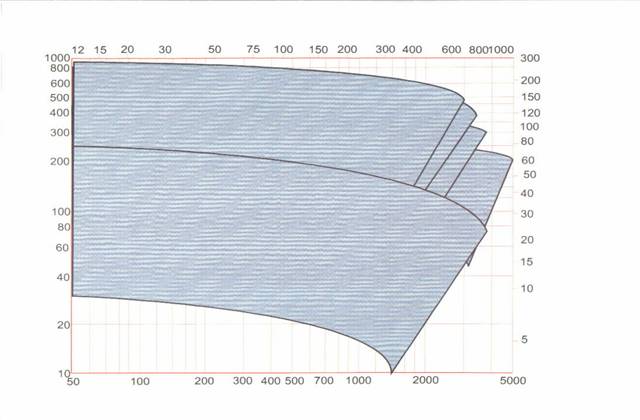
Family of Curves for Single Stage Units: |
|
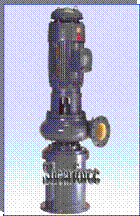
Typical Applications: Shearforce Rotor (SFR) are applications where Entrained gas (air) and/or Solids and/or Viscous and/or Shear sensitive fluids are being pumped in the Oil & Gas, Water & Wastewater, or Food & Beverage Industires. · DAF and Ozone Water Making Applications: Air can be injection into suction of Shearforce Rotor creating millions of tiny air bubbles improving the efficiency of any DAF or Ozone Water making process. · Entrained Chemical Gas: SFR can pump up to 20% entrained gas without affecting pump performance thus eliminating the need to remove gases produced in Chemical processes. |
|
History: The “Shearforce” concept is based on the natural physical forces of moving a fluid through a pipe or pump as described by Newton’s law of physics. The fluid is moved as a physical reaction to an applied force by the resulting “shear forces” created within the molecular structure of the fluid. Many people have studied the “shear force” pumping principal. Most experts question the practical application since the flow is transferred from a laminar state to a turbulent state resulting in increased friction and loss of efficiency. However the benefits are: · Pumping fluids with entrained gas/air (20%) · Pumping fluids with high solid content (50%) · Pumping fluids with high viscosity and solids (10,000 cp) · Pumping fluids which are shear sensitive. |
|
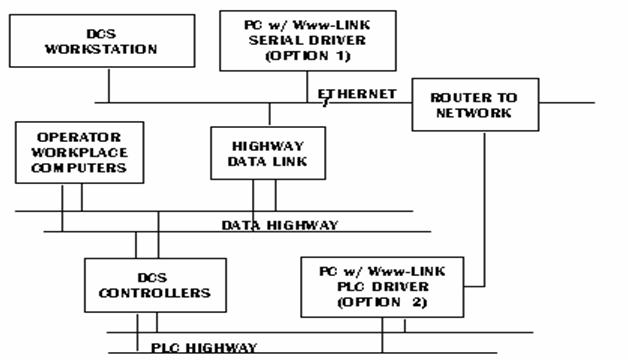
Pump Monitoring: Finally a “smart” product designed to integrate directly into the customer’s existing control system. The Shearforce Ltd. Co. has realized that most pump fail due to system irregularities. These include low suction pressures, accidentally closed suction or discharge valves, lack of fluid, and unstable systems. Www-Link is a patent pending software encompassing the Flex state of the art hardware to safely monitor and seamlessly distribute the information through the customers lan, wan or intranet. The essential component of Www-Link is the software’s ability to read any DDE complaint program. Www-Link the converts the information directly into any HTML format. Www-Link will reside on any PC network with TCP/IP connectivity and read the Flex through standard modbus drivers. |

|
· Latex Paint: SFR will not shear the Latex products producing a better product. · Mud Pumps: SFR will not shear the mud saving on additive chemicals. SFR can also handle the drill cuttings which are present in the mud. · Oil Sludge: Tank Bottoms, Saver Pits etc. SFR can handle high viscosity and solid content. · Oil Tank Loading: SFR will not emulsify the Crude Oil saving in de-emulsification chemicals. · Pharmaceutical Crystals: SFR will not damage the crystals used in producing many pharmaceutical products. · Plankton: SFR will not damage the living organisms. · Food Industry: SFR can be used in many A3 pumps to handle shear sensitive products. such as milk. |